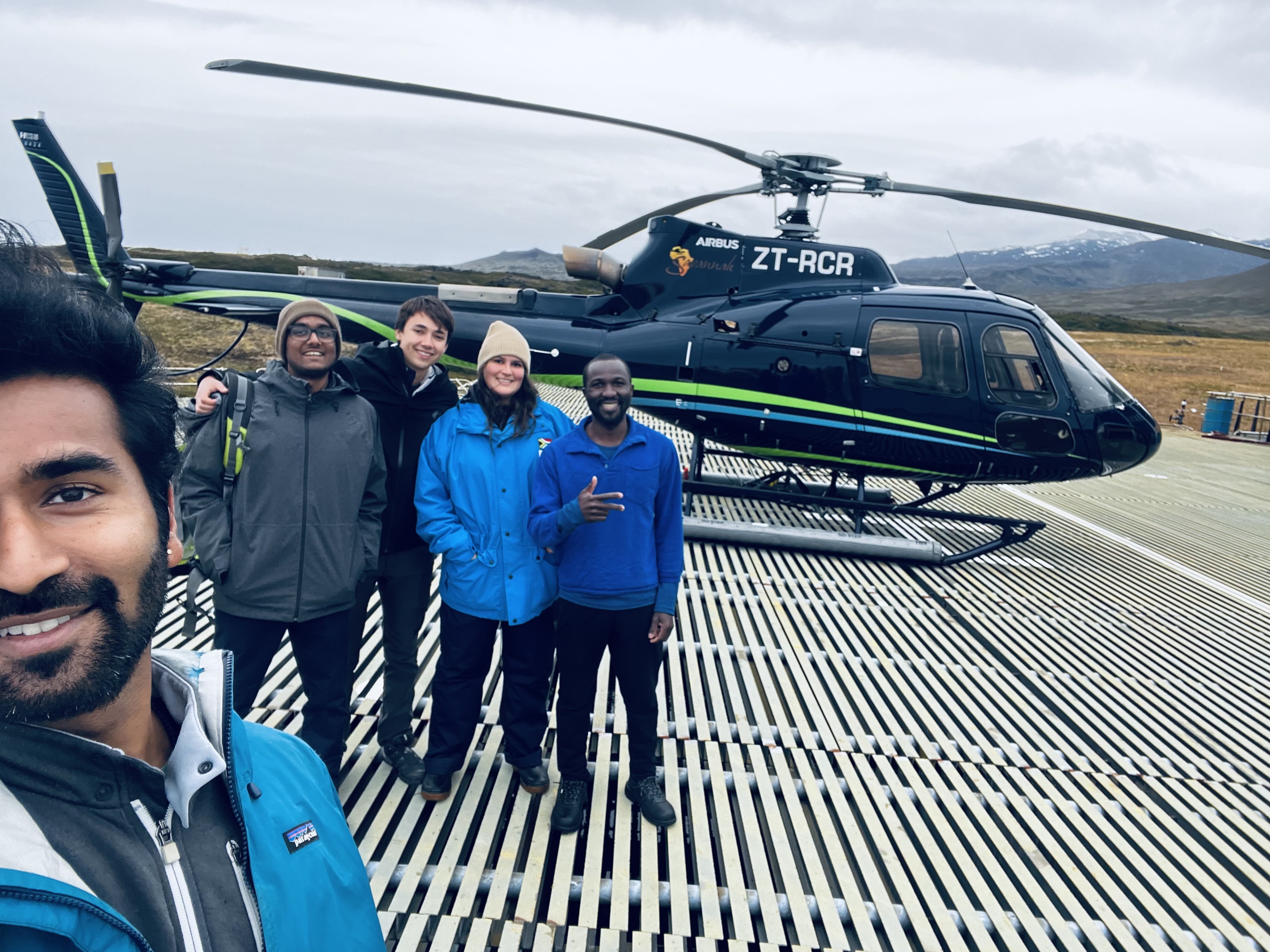
Marion Island has one of the most remote research stations in the world. Being so far from human settlements it’s a prime location to search for faint radio signals that tell us the origin story of the very first stars in the Universe. In 2023, I went down there with a team of astro-engineers for one final journey to retrieve our instruments and their precious data.
In previous post, I shared some parts of last year’s expedition preparation and told you about our experiments PRIZM and ALBATROS. Apart from the usual logistical challenges, this year’s major challenges were two-fold: test out our virtual 12 km-sized telescope and pack-up all instrumentation in time and return the island to its pristine state.
The 12 Kilometre Baseline
In the nick of time we managed to deploy our first remote ALBATROS station last year. Our overwinter in the mean time has brought the system online, despite being in a challenging location up on one of the volcanic hills. Unfortunately, the system hasn’t been producing data reliably. So we set out to do something impossible. In four weeks time, we’d make the trek to the Repetto’s station, retrieve the hardware, diagnose, fix and redeploy it. While at the same time starting packing up PRIZM and the lab. We would give the system 12 days to produce a unique data set along with the other ALBATROS stations.
While the first team was succesful in bringing our furthest station online, our base-based team started packing up PRIZM and the base. 12 days later we ventures out to Repetto’s again, a hike over a hill covered in volcanic rock, through muddy mires, an overflooded lake with penguins and elephant seals. We retrieved the data drives and packed up the instrumentation for their helicopter flight back.

Tears, Smiles and Goodbyes
After making the long trek back, we started a pre-analysis of the data, while wrapping up all the other tasks. Only to realise, the files were empty. The system was running for 12 days, outputting empty files. A heartbreaking discovery. It turned out that the system had just enough solar power to make it seem it was fully operational, but it didn’t get enough sun light to actually write data. The harsh reality of running experiments in harsh locations. Nevertheless, we finished up everything in time, and well within the buffer. So we negogiated permissions to explore other parts of the island. Two Astronomers guided by a sealer doing one last (and first) round-island in three island. The round island took us through the unique different geological landscapes of this beautiful island, forever etching those georgeous images in our minds.
Want to catch a glimpse of our 2023 voyage

 Ronniy Joseph